
DALI lighting automation is a system in which luminaires are individually addressed and controlled over a single two-wire digital line. DALI (Digital Addressable Lighting Interface) is an open protocol defined by the IEC 62386 standard, so it is not tied to any one brand. Unlike conventional on/off or 0-10 V dimming, every luminaire (driver) on the line has its own address and receives commands according to that address.
The protocol's basic limits are these: up to 64 devices can be addressed on a single DALI line, they can be assigned to 16 groups and 16 scenes, light levels are set across 254 logarithmic steps, and the line can run up to roughly 300 metres within the voltage-drop limit. In larger projects these limits are overcome by joining several lines under a DALI gateway or central controller.
DALI is often confused with DMX512 and KNX, but the three do different jobs. DMX512 is a one-way, very fast scene and effects protocol; it is strong for RGB shows but receives no feedback from the device. KNX is a building-automation backbone that connects heating, blinds and security alongside lighting. DALI focuses on lighting and is two-way: a driver can report fault and lamp status back to the controller. In practice projects are often mixed, with KNX managing the building and the lighting layer running on DALI.
DALI-2 is the updated version of the protocol. Besides drivers, control devices such as sensors, push-buttons and controllers are also certified, which guarantees interoperability between different manufacturers' devices. On a new project, specifying DALI-2 certified drivers and control devices greatly reduces the incompatibility problems that appear when the system is expanded later.
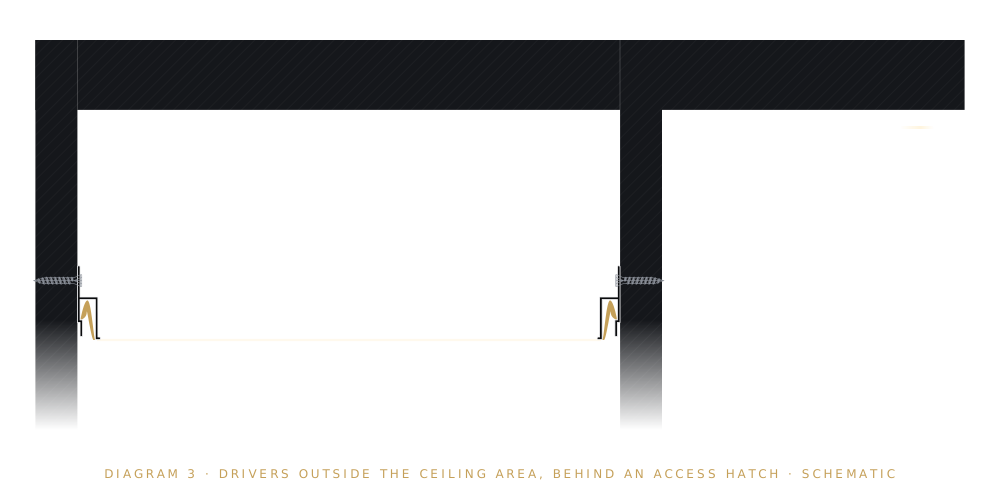
Using DALI in a stretch ceiling has its own engineering side. LED lines are fixed to the structural slab inside the ceiling area, while drivers and DALI line connections are usually gathered outside the stretch ceiling area, behind an access hatch in a plasterboard ceiling or technical void. The LED cables enter the ceiling area through a wall passage. This arrangement means the membrane never has to be touched to replace a driver or check a connection later. Where a driver must stay inside the ceiling area, an access hatch has to be cut into the membrane; in both cases hatch locations, driver heat dissipation and line topology must be planned before the ceiling is closed. Single-colour LED lines use DT6 drivers, while tunable white (warm-cool) and RGBW applications use DT8; if a tunable white design is planned, make sure the control layer supports DT8.
On the scene side, DALI's strength is that the same ceiling can be rewritten for different moments of use. In an office, meeting, presentation, cleaning and night modes; in a hotel lobby, morning, daytime and evening profiles; in a restaurant, light levels that change with service hours are all defined in advance and triggered with a single touch or a timer. When daylight and motion sensors are added, the lighting runs only when needed and at the level required, which noticeably lowers energy consumption.
The most common mistake in installation is to treat DALI as a driver selection alone. Three layers determine the system's lifespan: the drivers, the line topology and the addressing/scene software. If these three are not planned together at the outset, the system can't keep pace with growing automation needs over the years; in particular, with a closed, brand-dependent control software, even swapping a single driver model later can mean reprogramming the whole system.
To remove this dependency, we at Item Yapı are carrying out R&D on our own DALI control software and hardware. Our aim is not to make drivers; it is to develop DALI control software and hardware that scale to a project's needs, growing from a small space to a multi-line building. These solutions are being designed to work with all drivers that conform to the DALI standard, in other words to remove brand dependency. The work is at the R&D stage; if you would like to plan the DALI infrastructure of your project together with us, you are welcome to get in touch.